
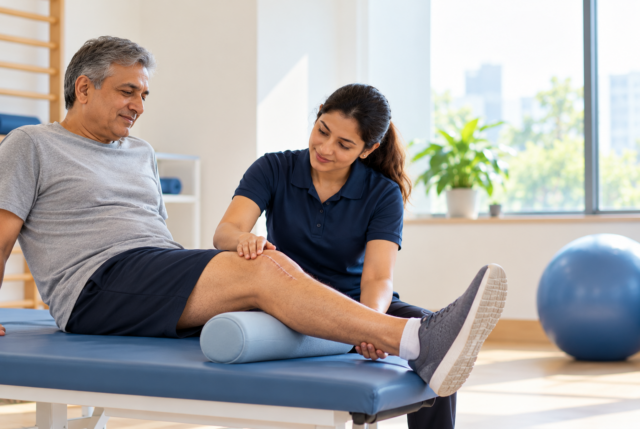
The morning after surgery, a physiotherapist asks you to stand on a knee that feels like it belongs to someone else. It’s swollen, stiff and quietly involuntary, rather unwilling. Most people are surprised by how soon this happens, and by how much the next few weeks depend on what they do with it. The procedure replaces the joint. Physiotherapy after knee replacement guides the new joint to bend, bear weight, and carry you through a normal day.
Below is a week-by-week plan showing what knee replacement recovery usually looks like, with one reminder up front: your surgeon’s protocol comes first, and every knee moves at its own pace.
Why Physiotherapy Matters After a Knee Replacement
Knee replacement physiotherapy has an obvious job. It reforms the knee’s ability to straighten fully and bend like before, rebuilds the thigh muscles that arthritis and surgery have weakened, and retrains your walking so you don’t carry a limp into the next decade. It is very helpful as it acts as a catalyst for the actual operation. Skip it, and the knee tends to stiffen while the muscles around it stay weak.
Rehabilitation usually starts within a day or so of surgery, often before you leave hospital. After that, the focus shifts every couple of weeks.
Progress is rarely a straight line. A good week can be followed by a stiff, swollen one after a long walk, and that’s an ordinary part of knee replacement recovery, not a setback.
Knee Replacement Recovery: A Week-by-Week Plan
Weeks 1 to 2: Calm the Knee, Start Moving
In these first days, you might experience swelling, pain control and gentle movement. You will walk with a frame or with the help of crutches, and you will repeat simple exercises after knee replacement several times a day: ankle pumps, tightening the thigh muscle against the bed, and sliding the heel back to bend the knee a little. Raising the leg and using ice as advised helps with swelling. Short walks around the house through the day keep stiffness from setting in. Don’t chase a number on the bend yet. Straightening the knee fully matters just as much, and it’s the part people overlook.
Weeks 3 to 4: Finding the Bend
Swelling starts to settle, and the knee feels more like yours. Many protocols aim for roughly 90 degrees of bend by about week four, enough to sit comfortably and get in and out of a chair. Your physiotherapist will add seated knee bends, assisted stretching and sit-to-stand practice, and you may begin a stationary bike with partial pedal turns once the range allows. Walking aids come down in stages, when your surgeon and physiotherapist agree you’re ready.
Weeks 5 to 8: Building Strength
Now the emphasis moves from movement to muscle. Step-ups, hamstring curls, mini squats and balance work take over, while gait training irons out the limp. A bend closer to 110 degrees is a common target at this stage. This is also when many people feel good enough to stop rehab. Don’t. The strength you build now is what makes stairs and longer walks feel easy later.
Weeks 9 to 12: Back to Real Life
Sessions start to mirror what you actually do: longer walks, stairs one foot per step, getting up from a low seat, standing steadily on the operated leg. Research tracking knee movement over a year found that most gains arrive in the first 12 weeks, with smaller changes continuing up to about six months.
After Three Months
Formal sessions for exercise after knee replacement usually taper into a home programme. Strength and confidence keep improving, and some end-of-day swelling can linger for months. Full recovery often takes six months to a year.
How Hard Should You Push?
Some stretch and soreness during exercises after knee replacement is usual, and it should settle within an hour or so. Sharp pain, a knee that balloons overnight or a sudden drop in your bend means you have done too much, so ease off and tell your physiotherapist, as it needs more time to cope with your usual routine exercises that felt normal and easier before the procedure.
Short, frequent sessions beat one heroic effort. Five or six gentle rounds spread across the day keep the joint moving without flaring it up. Take your prescribed pain relief before a session, not after, so you can actually do the work.
And try not to treat degrees as a scoreboard. A neighbour who bent to 120 in week five isn’t a benchmark for you. Age, how stiff the knee was before surgery and your own healing all shape the curve.
Making Recovery Work in Mumbai
Many standard recovery guides assume chairs, lifts and Western toilets. Real homes here are different. Plenty of South Mumbai buildings have steep stairs and no lift, and floor seating, Indian-style toilets and cross-legged sitting for prayer ask far more of a new knee than a dining chair does. Talk to your surgeon about which of these are realistic for you, and let your physiotherapist in South Mumbai rehearse safe alternatives, such as a raised toilet seat, before you need them. Getting into an auto-rickshaw or taxi, with its low seat and narrow door, is another movement worth practising before your first outing. Monsoon-slick bathroom floors deserve the same respect. Ask your surgeon before you drive or take a local train, since the right timing depends on which knee was operated and how you’re healing.
When to Call Your Surgeon Instead of Waiting
Calf pain, swelling or warmth, especially if it’s on one side, can point to a blood clot and should be reported the same day. So should a fever, or a wound that turns red or hot, or starts to leak. Some bruising and swelling are expected, but a bend that stops improving over several days is worth a call too, since early stiffness is far easier to treat than late. Sudden breathlessness or chest pain needs emergency care straight away. Don’t wait for your next physiotherapy session to raise any of this.
Physiotherapy After Knee Replacement Surgery in Mumbai
At Healthspace Clinic, near Charni Road station, rehabilitation is built around your surgeon’s instructions and what your knee is doing that week, not a printed schedule. Our team at HealthSpace brings over 35 years of hands-on experience in knee and musculoskeletal care to a physiotherapy service in South Mumbai that also offers home visits for patients who aren’t ready to travel.
If you’re planning surgery or already a few weeks in, starting structured physiotherapy after knee replacement early gives your knee the best chance of moving well for years to come.

